
Roads are shared by different vehicles alike, driven by differently skilled drivers at varying speeds. Statistics from the CDC on Global Road Safety reveal that 1.19 million individuals lose their lives every year in road accidents around the globe.
Although driving is a daily activity for a lot of individuals, we don’t often consider the risks of driving on dual carriageways and the role of NJ barriers in preventing accidents. This article answers some important questions, like:
- What are the NJ barriers?
- Types of NJ barriers
- Cause of accidents on dual carriageways
- Role of NJ barriers in preventing crossover accidents
What Are NJ Barriers
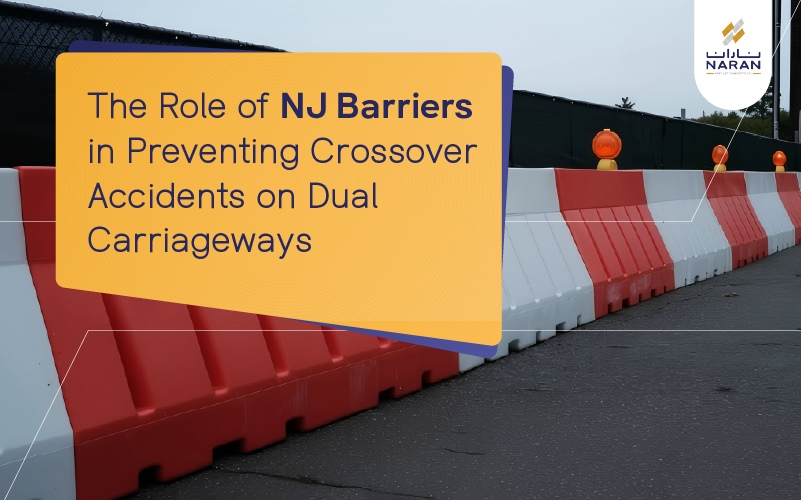
NJ barriers, or Jersey barriers, are pre-type structures that help maintain traffic and safety. They are also called the Jersey wall or the Jersey bump. First used in the 1950s by the state of New Jersey between highway lanes as “separators,” these modular structures have become indispensable today. Since they’re made off-site, all you need to do is bring them to the site and install them permanently or temporarily.
The key design features of an NJ barrier are as follows:
- They boast a sloped or curved profile so that the vehicle’s tyres move up the slope and spin back slowly. This allows the driver to regain control.
- They’re tall enough to prevent the vehicles from overriding.
- Heavy concrete is built, like steel-reinforced poured concrete or plastic, for durability and stability.
Types of NJ Barriers
Different types of barriers exist today to fulfil varied needs. However, their basic function remains the same. Here’s a breakdown for you!
| Type | Pros | Cons |
| Concrete Barriers | Best for high-speed highways Ability to withstand high impact, like loaded trucks. Often crash-resistant Best for long-term projects | Heavy and expensive compared to other types Requires investment in transporting, placing, and removing them |
| Water/Sand-filled plastic barriers | Lightweight and eye-catchy Cost-effective Flexible You can transport them in bulk Best for temporary work zones, pedestrian areas, and lower speed setups | You will have to pour water or sand into them to increase their weight Lesser impact absorption capability May wobble upon collision |
| Metal road barriers | More durable and heavier Can be quickly installed with minimal efforts They cover almost the entire width of the road Can also be used at concerts and public events Ideal for overnight repair or emergency use | More expensive |
Cause of Accidents on Dual Carriageways
A crossover accident occurs when a vehicle leaves its lane, crosses the median and collides with the vehicles moving in the opposite direction. This is very common on dual carriageways because vehicles move at high speeds here.
Some of the common reasons why vehicles may cross the median and collide are:
- High speed and loss of control
- Poor road conditions, like wetness or slippery surfaces
- Driver fatigue or distraction
- Tyre blowouts or other mechanical failures in the vehicle
Crossover accidents result in a head-to-head collision with great force. This intensifies the impact of the crash, resulting in severe injuries.
Role of NJ Barriers in Preventing Crossover Accidents
1. Redirect Vehicles Instead of Head-On Collisions
The slope or curved end of the NJ barrier is strategically designed to force the vehicle’s tyres to move upwards and spin inward. Moreover, the concrete construction of the barrier pushes the vehicle back into its own lane rather than letting it cross over to the opposite lane and crash into another vehicle.
2. Protects Workers
Another application of NJ barriers lies in road construction. Carrying out operations in fast-moving and high-traffic areas requires more vigilance and protection. These barriers physically separate the vehicles from the workers, ensuring safety.
3. Reduces Impact
When a vehicle loses control, sudden decelerations can result in a vehicle rollover. This not only impacts the vehicle but also puts the driver’s life at high risk. NJ barriers reduce this impact by absorbing the crash energy.
4. Maintain Lane Discipline
NJ barriers not only restrict the impact but also help prevent accidents in the first place. They clearly divide the road, ensuring that vehicles stay in their own lanes. This reduces the chances of overtaking and speeding. They’re less likely to drift or have unsafe takeovers when a visible barrier continuously separates the opposing lane.
5. Blocking Opposite Headlights
Tall NJ barriers are great at blocking the headlights from the opposite lane. This helps to reduce glare at night, improving visibility and reducing accident risks.
NaranPCC’s high-quality precast NJ barriers are made with concrete material, which minimises the impact on vehicles. They’re built off-site, requiring only transportation and direct installment at the site of your choice. Their durability makes them ideal for accident prevention in high traffic and high-speed zones as well as for maintaining driving lanes.
FAQs
Are NJ barriers practical for trucks?
Yes, NJ barriers are practical for trucks as they minimise vehicle damage and prevent head-to-head collisions. Opt for concrete barriers for better safety.
Can NJ barriers be used temporarily?
Yes, they can be. Water/Sand-filled plastic and metal road barriers are excellent for temporary use. They’re also multipurpose, useful for crowd management on buddy roads and events.
Will the NJ barriers last long?
It depends on the build of the barrier and the force it is expected to handle. Concrete and metal barriers are the strongest and long-lasting.
Can NJ barriers suffer damage?
Yes, in some cases. Water or sand-filled plastic barriers may wobble upon collision. Concrete NJ barriers are much stronger and experience less damage during high-impact collisions.