
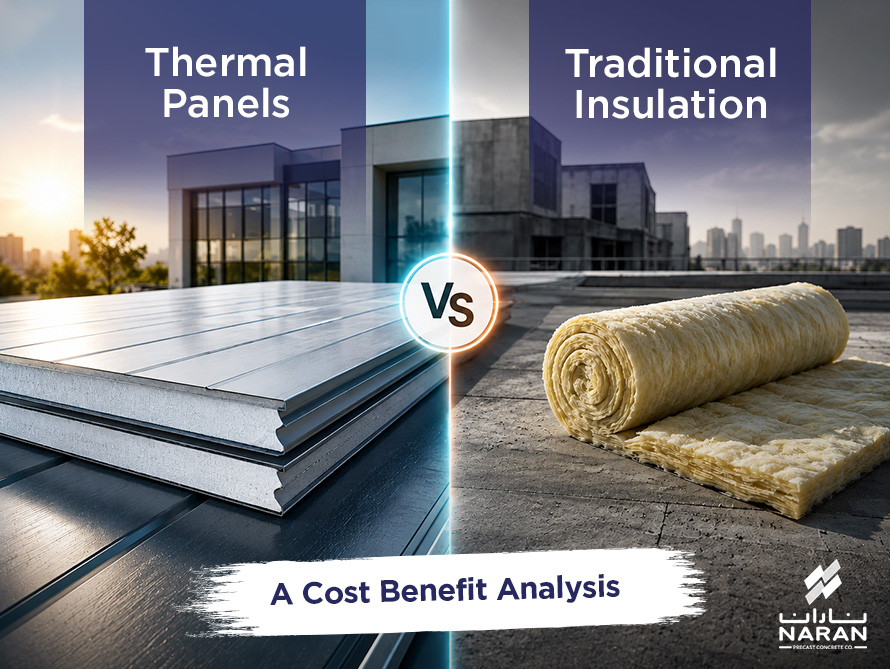
Traditional insulation is cheaper to buy. That’s exactly why many projects choose it. However, the purchase price is only one line in the budget.
A wall system also affects how many people are needed on site, how quickly the building goes up, and what it costs to run and maintain for years after handover. That’s where precast thermal panels often start to justify their higher price, especially on larger commercial and industrial projects.
This cost-benefit analysis breaks down those factors to help you decide which option delivers better value for your project.
Key Takeaways
- Traditional insulation is usually the cheaper option upfront.
- Precast thermal panels cost more at first, but they can cut labour, speed up construction, and reduce long-term costs.
- On large commercial and industrial projects, those savings often make precast thermal panels the better investment.
- For smaller projects with tighter budgets and flexible timelines, traditional insulation is still a practical and cost-effective choice.
Quick Cost-Benefit Comparison
| Cost Factor | Traditional Insulation | Precast Thermal Panels |
| Upfront cost | Lower | Higher |
| On-site labour | Higher | Lower |
| Construction time | Longer | Shorter |
| Site coordination | More trades | Fewer trades |
| Energy performance | Installation-dependent | More consistent |
| Maintenance | Higher | Lower |
| Best suited for | Small projects | Large commercial projects |
Where Does the Cost Difference Actually Come From?
With a traditional insulated wall, the work happens in stages. The structural wall is built first. Insulation is installed later. Moisture barriers, cladding or finishes, sealants, and other components follow. Different trades work one after another, each depending on the previous activity being completed correctly.
Precast thermal panels take a different approach. The structural concrete and insulation are manufactured together in the factory before arriving on site. Once the panel is lifted into place, much of the wall assembly is already complete.
That difference changes almost every cost category on the project.
Material Cost
The purchase price of insulation boards, batts, or cavity insulation is generally lower than an insulated precast panel. If material cost is the only factor being measured, traditional systems often appear to be the more economical choice.
However, projects are not built using material costs alone.
Labour
From here, the comparison starts to change. Traditional wall assemblies require several installation activities carried out by different trades. More people spend more time on site, and every handoff introduces another opportunity for delays or workmanship issues.
Integrated precast systems reduce many of those activities because the wall and insulation arrive together. That doesn’t eliminate labour, but it often reduces the amount of site work required.
Construction Schedule
Time has a cost. Every extra week on site means additional supervision, equipment hire, temporary facilities, financing costs, and exposure to bad weather.
Since precast panels are installed as completed wall units, buildings can often be enclosed much earlier than with conventional wall construction. Interior trades may begin sooner, helping shorten the overall programme.
For projects where opening earlier generates revenue or avoids penalties, those schedule savings can become financially significant.
Long-term Operation
Construction is a one-time expense, but energy bills, maintenance, and repairs continue for decades.
Well-designed precast thermal panels help create a consistent thermal envelope because insulation is incorporated during factory manufacturing rather than installed piece by piece on site. That consistency can support better long-term thermal performance, provided the joints and connections are properly detailed during installation.
Apart from lower energy use, it leads to greater confidence that the wall will perform as it was designed.
When Paying More Actually Saves Money
Suppose a developer is building a 40,000-square-metre distribution centre.
Every extra week spent on construction means spending more money on workers, equipment, site expenses, and loan payments. If precast thermal panels help finish the building a few weeks earlier, the money saved from finishing sooner may be more than the extra money spent on the panels.
Now consider a homeowner building a small extension.
The project uses fewer workers, the construction schedule is shorter, and bringing the building into use two weeks earlier is unlikely to change the overall financial outcome. In this situation, traditional insulation may deliver better value because the benefits of precast are less pronounced.
This is why there isn’t a universal winner. The right choice depends on where the project creates value.
Traditional insulation is often the better choice when keeping the starting cost low is the main goal. Precast thermal panels are often the better choice when the goal is to use less on-site labour, keep the project on schedule, and save money over the building’s lifetime.
Experienced developers do not only look at which wall system costs less. They choose the one that gives the best value for the project in the long run.
The Better Question to Ask
Instead of comparing insulation products, compare the total cost of delivering the building.
Before making a decision, ask:
- How much does every additional week on site cost?
- Is skilled labour readily available for this project?
- Will earlier completion generate financial value?
- How long will the building be owned and operated?
- Are lower maintenance and energy costs important over the building’s lifetime?
The answers make the decision much clearer than a material quotation ever will. The best wall system is not always the cheapest one. It is the one that saves the most money and works well for many years.
For many big buildings, precast thermal panels are worth paying more for. They can save money over time. For smaller buildings with a smaller budget, traditional insulation is usually a better choice.
Not sure which wall system is right for your project? Get in touch with our team, and we’ll help you compare the costs and choose the best long-term solution.