
Concrete is key to every modern construction project in the UAE and beyond. The overall costs, durability, and timeline of a project depend on the type of concrete you use for construction.
Traditional on-site concrete pouring and precast concrete are two main options that most construction projects use. The biggest difference between these two approaches has to do with the location where concrete elements undergo formation.
Traditional concrete structures result from on-site pouring of concrete. Precast concrete, on the other hand, refers to off-site factory construction of concrete elements that manufacturers deliver to the construction site for installation. Precast concrete products and traditional concrete differ in terms of quality control, costs, labor requirements, design flexibility, durability, and construction speed.
This blog covers these concrete types in depth to help you understand what makes each useful in its own way.
In this article
- Precast vs Traditional Concrete: Comparison Table
- What Is Precast Concrete?
- What Is Traditional Concrete?
- 7 Key Differences Between Precast and Traditional Concrete
- Which Is Better for Construction Projects in the UAE?
Precast vs Traditional Concrete: Comparison Table
To understand what makes precast vs traditional concrete different, here is a comprehensive comparison table that you need to look at.
| Feature | Traditional Concrete | Precast Concrete |
| The Manufacturing Site | Workers mix, pour, and cure this concrete on site. | The construction of concrete elements takes place in factories. |
| Speed of Construction | Speed is lower, as many sequential steps are needed to make concrete structures. | Construction speed increases as the site preparation and concrete manufacturing take place simultaneously. |
| Quality Control | The quality is subject to site conditions and workmanship. | Careful factory production results in better quality control. |
| Initial Costs | The initial cost is less due to on-site work with traditional tools. | The initial cost is high due to high manufacturing or transportation costs. |
| Weather Impact | Concrete pouring and curing are both affected by weather. | Concrete production is not affected by weather on the site. |
| Installation | No need for lifting equipment as you prepare every component in its place. | You need precise lifting or handling tools for installation. |
| Site Disruption | Creates on-site disruptions. | Reduces on-site disruptions. |
| Best For | Projects with difficult access or complex customization requirements. | Projects with repetitive, time-sensitive, and large-scale concrete element requirements. |
What Is Precast Concrete?
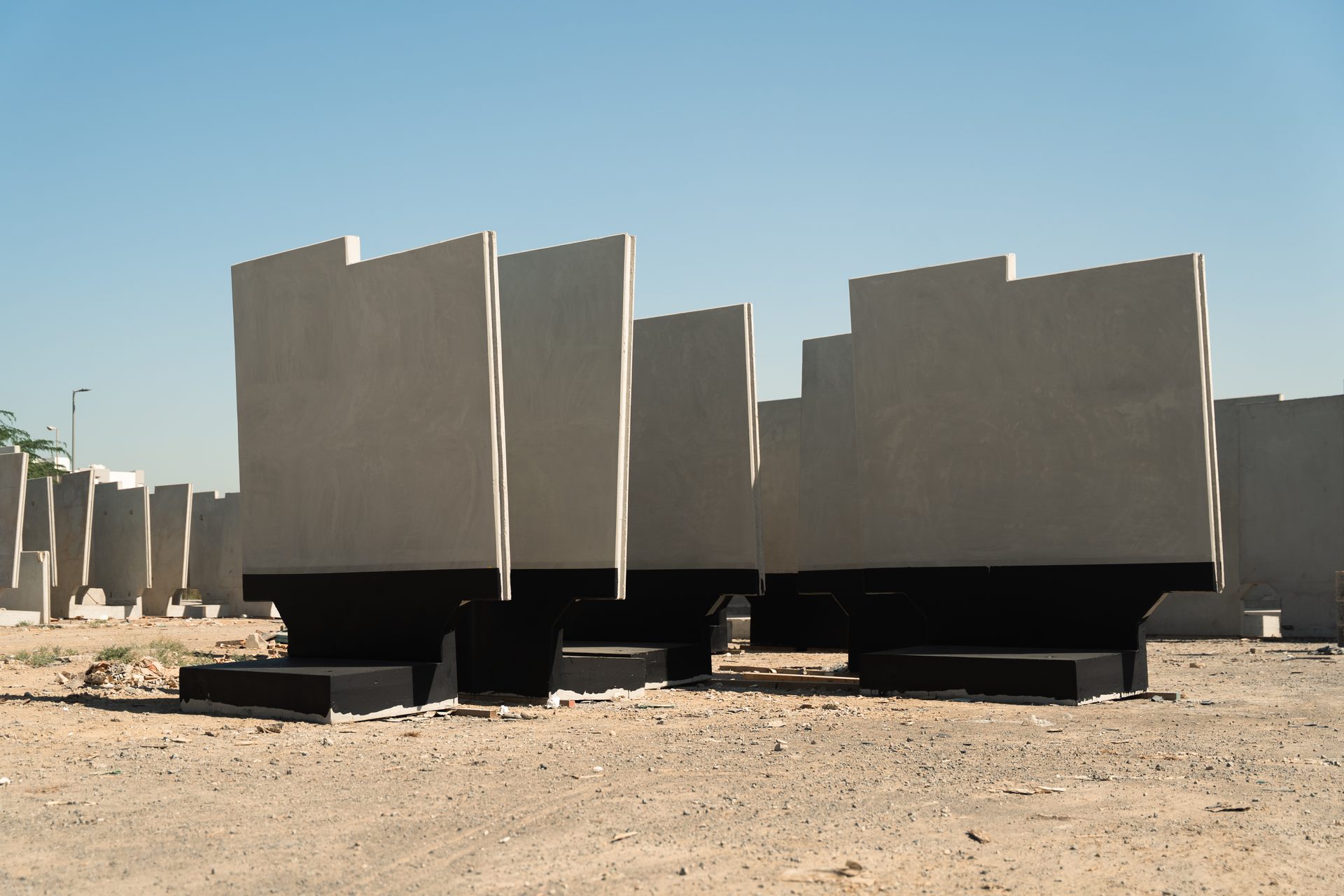
Precast concrete is an innovative construction approach where manufacturers prepare concrete elements in controlled factory conditions away from the actual construction site.
Manufacturers use molds to prepare concrete panels, beams, and other structural elements that we use for construction. After concrete mixing, pouring, and steel reinforcement, these elements arrive at the construction site where experts install them with the help of cranes or other advanced lifting tools.
The factory preparation of concrete elements results in much better control over concrete mixing, curing, reinforcement placement, and dimensional accuracy. This results in concrete structures that are highly uniform as well as structurally strong.
Precast construction also results in less on-site waste and transportation or construction emissions. This leads to 4.49% lower total life-cycle GWP or global warming potential.
And not just that, precast construction allows you to prepare concrete elements irrespective of the weather conditions on site. This not only results in more construction efficiency but also significant cost savings.
What Is Traditional Concrete?
Traditional cast-in-place concrete construction is a common practice where experts mix and pour the concrete on site. First, you erect the formwork as per the design. Then you add reinforcement and finally pour the concrete on site. After these steps, you have to let the concrete cure to achieve a uniform finish.
Traditional concrete works best when the transportation of a large number of concrete elements to a remote site is not feasible. This concrete is also a better option in projects where the design requires a higher level of customization.
7 Key Differences Between Precast and Traditional Concrete
Here is a more in-depth look into the key differences between precast vs traditional concrete to help you choose an option that meets the needs of your project.
1. Location of Production
The preparation of precast concrete structural elements takes place in dedicated factories. Every process from concrete mixing to pouring to curing happens away from the actual construction site.
On the other hand, you mix and then pour the traditional concrete on site. This makes the process dependent on site conditions.
2. Construction Speed
Precast concrete results in greater construction speed. The concrete elements undergo formation in factories. At the same time, workers excavate or create foundations on site. These simultaneous processes allow you to achieve more construction speed.
Studies show that the factory production of precast systems eliminates much of the on-site formwork, curing and reinforcement-placement work. This results in about 29.3% faster project completion than cast-in-place slabs.
With traditional concrete, you have to follow a sequence. First, you install the formwork, and then you add reinforcement. After that, you pour the concrete and let it cure.
Each of these processes takes a considerable amount of your time. The waiting periods for concrete mixing or curing, and weather conditions, can further interfere with the process, which results in slower construction speed.
3. Quality Control
Precast construction gives you more control over the quality of concrete elements. This approach uses standard molds along with optimized mixing or reinforcement procedures. This allows you to create concrete elements with consistent dimensions. You can also modify the processes to create precast concretes with specific sizes, weights, or load-bearing capacities.
The traditional concrete approach gives you less control over the quality, as it is subject to human errors and weather conditions. To ensure better quality, you have to pay attention to everything from correct design to proper placement and curing.
4. Cost
Precast concrete comes with higher initial costs. The fabrication of precast elements takes place in high-end factories. After preparation, you have to transport these elements to the construction site. After transportation, you have to install these elements with lifting tools. All of these processes increase costs.
However, the overall ROI with precast concrete is still high. Factors like less on-site labor, quicker installation, fewer delays, etc., compensate for the high initial cost. Research shows the overall lifecycle costs of precast concrete systems are 21% lower than cast-in-place concrete. The same study shows the construction phase cost is about 38% lower when you use precast concrete instead of traditional concrete.
With traditional concrete in building construction, the initial costs can be a bit lower as the concrete preparation on site eliminates transportation or installation expenses. However, factors like the need for extensive formwork, longer construction periods, and weather-related delays can increase costs significantly in this case.
5. Labor Requirements
With traditional concrete, you need more labor to do tasks like formwork preparation, concrete mixing, reinforcement placement, concrete pouring, and formwork removal.
With a precast approach, the manufacturing facility takes care of most of these processes. You only need a few hands on the site to position and install the concrete elements in this case.
6. Durability and Performance
The controlled manufacturing and optimized processes result in much better performance of precast concrete. The surface uniformity or dimensional consistency of concrete elements results in more durability. It also helps you produce components with predictable concrete properties even in harsh conditions.
Traditional concrete also offers great durability. However, for better performance, you have to pay attention to things like concrete mixing, reinforcement detailing, workmanship, and proper curing on site.
7. Design Flexibility
Precast concrete offers great customization in structural designs. But most of the customization happens earlier in the project. You need to determine the designs beforehand to arrange for appropriate molds for precast concrete preparation. Once the molds are ready, the customization is not simple. Precast concrete is better for customization in projects where you need to install repetitive components in standard sizes.
With traditional concrete, you can enjoy more design flexibility, especially when you need to create concrete elements with unusual shapes. This makes traditional concrete better for projects where the dimensions of concrete elements change during the construction phase.
Which Is Better for Construction Projects in the UAE: Precast or Traditional Concrete?
There is no clear winner between precast and traditional concrete. Each has its own merits, and the option that is best for you depends on your specific project requirements.
Overall, precast concrete is a better option in large-scale projects with shorter timelines. This approach works best in projects that involve the installation of repetitive components. The use of precast concrete results in better quality control, speed, and fewer labor requirements.
You need to use traditional concrete if the project needs concrete elements with more design flexibility or unusual dimensions. This approach also works best for projects in remote locations where the transportation of precast components is not possible.
An ideal approach is when you combine both methods. For repetitive elements, you can use precast concrete that offers exceptional structural strength. For foundations or unique structural elements, you can use traditional concrete. This ensures the project results in better structural performance as well as aesthetics for years.
Conclusion
Most modern projects in the UAE rely heavily on precast and traditional concrete. Precast concrete works best in large-scale projects where speed, quality control, and cost savings are your biggest concerns.
For projects with design complexity or limited road access, traditional concrete works best. Precast concrete reduces on-site work and labor requirements. Traditional concrete, on the other hand, relies on simpler concrete handling methods and eliminates the need for transportation of concrete elements.
This approach, however, results in less quality control along with more skilled labor requirements. This is why, to make a better decision, you need to look at your project specifications like budget, location, and labor availability. This can help you choose an option that results in both a high ROI as well as long-term durability of the project.
Contact Naran Precast Concrete Co. today to get fully customized precast concrete solutions for all types of projects in the UAE.