

Many villa plots and project sites in the UAE need space outside the main building. It might be a majlis in the garden, a driver’s room near the gate, or a guard room at the entrance to a site. These annex buildings are small, but building them the traditional way still means weeks of blockwork, plastering, and curing on site.
But what’s the advantage of a precast annex building over a traditional block-built one? And is it the right option for your plot?
We’ll look at where precast annex buildings are used, how they speed up construction, and what to plan for before you place an order.
Key Takeaways
- Precast annex buildings are made in a factory and assembled on site, either from panels or as ready-made rooms.
- They suit villa annexes, guard rooms, site offices, labour accommodation, and utility rooms.
- The factory casts the walls and roof while the site is being prepared, so the two stages run at the same time.
- Precast work is less affected by summer heat and needs fewer trades on site.
- Approvals, crane access, and service openings need to be sorted before casting starts.
Precast vs. Block-Built Annexes: A Quick Comparison
| Factor | Block-Built Annex | Precast Annex Building |
| Where the work happens | Almost all on site | Mostly in the factory |
| Build sequence | Foundations, then walls, then roof | Site prep and casting at the same time |
| Effect of summer heat | Slows curing and site work | Curing done in the factory |
| Trades on site | Masons, plasterers, painters | Small installation crew |
| Finish | Plaster and paint, varies by crew | Finish cast into the concrete |
| Disruption on an occupied plot | Weeks of noise and dust | Short installation period |
| Site requirements | Space for materials and mixing | Access for a truck and crane |
What Are Precast Annex Buildings?
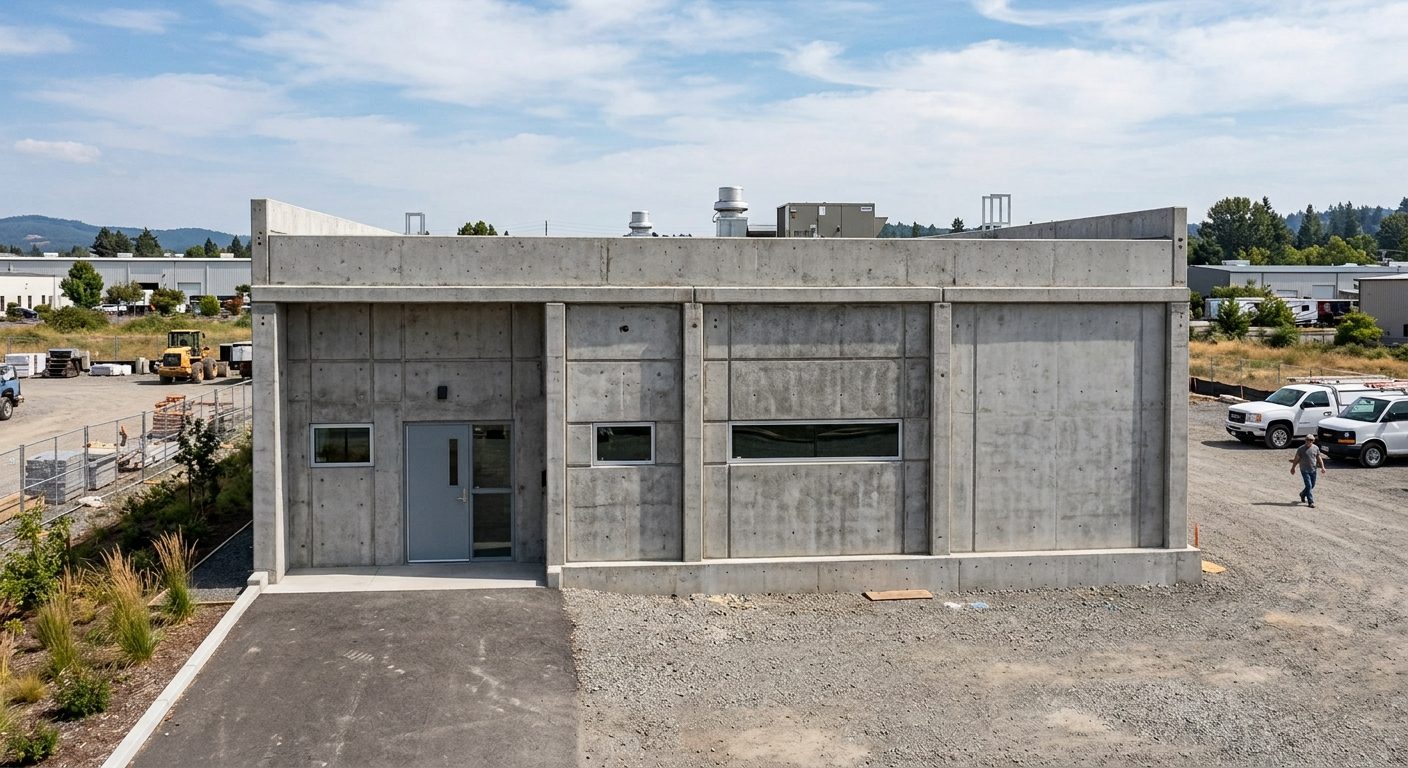
A precast annex building is a secondary building on a plot, made from concrete elements cast in a factory. It can stand on its own or sit next to the main building.
There are two common ways to build one. The first uses precast wall panels and roof slabs. These are delivered to site and connected on a prepared foundation, so the annex goes up in days rather than weeks. The second is a ready-made room, cast and finished in the factory, then lifted onto its base as a complete unit. Guard rooms are often built this way.
Both methods fall under our range of precast concrete buildings, where dimensions and finishes are made to order.
Where Precast Annex Buildings Are Used in the UAE
Annexes serve very different purposes depending on the plot. These are the most common uses.
Villa Annexes
On residential plots, an annex often holds a majlis, a guest suite, or rooms for household staff. Some owners add an outdoor kitchen or a gym. Precast panels can be finished to match the main house, which matters when the annex sits in full view of the garden. If you’re planning the whole home in precast, our precast villas follow the same approach.
Guard Rooms and Gatehouses
Factories, warehouses, schools, and residential compounds all need a staffed point at the gate. A precast guard room arrives ready to use and can be in place within a short installation window. The concrete shell also stands up well to sun and dust at an exposed entrance.
Site Offices and Labour Accommodation
Large projects need offices, rest areas, and housing for workers. These buildings have to go up early in the programme, often before the main works start. Precast labour accommodation gives a durable option that can be planned in repeated blocks.
Utility and Service Rooms
Electrical rooms, pump rooms, and generator rooms are usually small and simple in layout. They are a natural fit for precast, since the same room design can be repeated across several plots or sites.
How Precast Annex Buildings Fast-Track Construction
Speed is the main reason clients choose precast for an annex. The time saving comes from a few specific places.
Factory and Site Work Happen Together
With a block-built annex, each stage waits for the one before it. The foundation cures, then the walls go up, then the roof is cast, then the plastering starts.
With precast, the factory casts the walls and roof slabs while your contractor prepares the foundation. By the time the base is ready, the elements are ready too. Our comparison of precast vs cast-in-place concrete covers this difference in more detail.
Less Exposure to Heat and Weather
In a UAE summer, on-site concrete needs careful curing, and crews often work shorter hours in the midday heat. Precast elements are cured in the factory under controlled conditions. On site, the work is mostly lifting and connecting, which takes far less time in the open.
Fewer Trades on Site
A block-built annex brings in masons, then plasterers, then painters, each waiting on the last. A precast annex needs a small crew to place and connect the elements. Fewer handovers mean fewer gaps in the schedule.
The Finish Arrives With the Building
Precast walls can be cast with a texturized, exposed-aggregate, or coloured finish already in place. There’s no separate plaster coat to apply and wait on, and the finish stays consistent from one wall to the next.
Less Disruption on an Occupied Plot
Many annexes are built on plots where a family already lives. Weeks of mixing, cutting, and plastering next to a lived-in home is hard to manage. A precast annex keeps most of that work away from the plot, and the installation itself is over quickly.
How to Plan a Precast Annex Building
Precast moves fast once production starts, so most of the planning happens before that point.
Approval comes first. Annexes on villa plots usually need a permit from the local municipality, and plots in master-planned communities may also need sign-off from the developer. Check setbacks, height, and how close the annex can sit to the boundary wall before the design is fixed.
Think about access next. The elements arrive on a truck and are lifted with a crane, so the route to the plot and the space beside the annex both matter. A narrow side gate or overhead cables can change how the installation is planned.
Decide on services early. Openings for doors, windows, AC units, electrical conduits, and plumbing are cast into the panels. Moving one after casting is difficult, so the layout needs to be final before production.
Make sure the foundation is ready on time. The precast elements need a level, cured base to sit on. If the base runs late, the delivery has to wait.
Finally, match the finish to the main building. On a villa plot, the annex should look like it belongs with the house, and the right finish choice at the start makes that easy.
Conclusion
Precast annex buildings take most of the construction work off site. The factory casts the walls and roof while the foundation is prepared, the finish arrives built-in, and the installation itself is short. For villa owners, compound managers, and contractors who need extra space quickly, that time saving is the main benefit.
The trade-off is planning. Approvals, access, and service openings all need to be settled before casting starts. Get those right, and a precast annex can go up in a fraction of the time a block-built one would take.
Visit us at Naran Precast Concrete Co. today to explore our precast buildings, from villa annexes and guard rooms to labour accommodation, or request a quote for your project.